



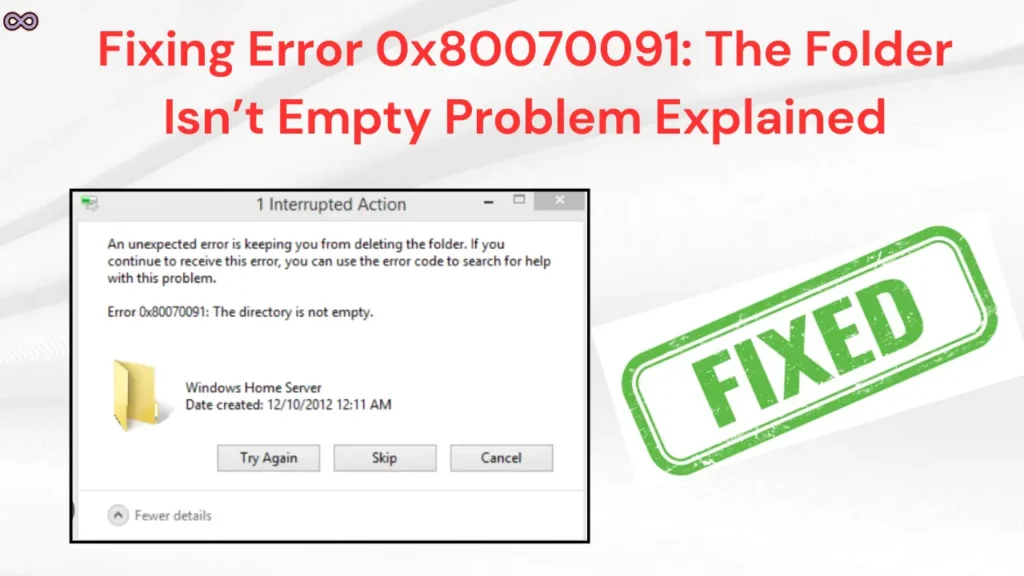
When you encounter error 0x80070091 while deleting or restoring a folder in Windows, the solution is straightforward: Windows believes that the folder is not empty because it has permission issues or is corrupted. However, please do not panic; it can be fixed in a couple of easy steps.
To understand what this error means, why it occurs, and what you can do to recover error 0x80070091, which does not require deleting your files, it is time to break this error down.
Table of Contents
What error 0x80070091 actually means
No.1003531072: The directory is not empty.
This notification tends to appear at the time when you are attempting to:
- Erase or rename a folder on your personal computer.
- Recover Windows Backup or File History files.
- Install System Restore or Windows Update.
In essence, Windows has a file or folder clash – Windows believes that there is information in the desired folder, although you may have previously deleted it.
Why does error 0x80070091 happen
In real-life experience, this failure tends to manifest itself due to one (or a combination of) the following:
- File system corruption. A corrupt or a deleted folder record causes Windows to assume that the directory is in use.
- Permission issues. The folder may not be under your complete control, particularly in a system-protected area.
- Malware or antivirus locks. Even when you are not using some background apps, some of them can maintain files as open.
- Defective external drive or storage. In case of deletion in a USB or external HDD, bad sectors may lead to this.
Being honest, Windows does not do so well in providing simple error messages in plain English. It is, fortunately, easy to correct this directly.
Step-by-step fixes for error 0x80070091
This is the way of safely troubleshooting error 0x80070091:
1. Close File Explorer and restart it
- Click on Ctrl + Shift + Esc to open Task Manager.
- Locate Windows Explorer, open it, and press Restart.
- Re‑try deleting the folder.
In case the error comes back, pass to the next step.
2. Use Command Prompt (Admin)
rd /s /q "C:\Path\To\Your\Folder"
Reading: Set up your file system so that every document in it can be accessed by an application. Reading: This is to create a system that allows all the documents in your system to be read by an application.
This will delete the folders even when Windows believes that they are not empty.
3. Run CHKDSK to fix corruption
chkdsk C: /f /r
The CHKDSK utility corrects problems with the file system, which is likely to generate error 0x80070091.
4. Take ownership of the folder
- Select the folder by right-clicking it and clicking the Security tab.
- Click Advanced > Change owner.
- Enter your username, press Check Names, and use it.
- Select “Replace owner on subcontainers and objects.”
Once it has been owned, deleting the folder must be an easy task.
5. Start Safe Mode or start PowerShell
- Safe Mode (Shift + Restart > Troubleshoot > Advanced Options).
- Open PowerShell with administrator privileges and execute:
Del -Path "C:\Path To Your Folder" -Recurse -Force
This bypasses regular file lockouts and deletes all of this correctly.

Quick at a glance: Fix error 0x80070091
Bonus tip: 0x80070091 in Windows Backup or Windows Restore
When you are getting the error of 0x80070091 when restoring your system, it usually appears that the WindowsApps folder (located in Program Files) did not restore properly.
- Shut down to recovery mode (Shift + Restart).
- Click Troubleshoot > Advanced Options > Command Prompt.
- Run:
rd /s /q C:\Program Files\WindowsApps
 Mkdir C:\Program Files\WindowsApps
This repair has solved the problem for many users when the standard restore efforts failed.
Also Read: 9 proven ways to fix the window access is denied error in Windows 10/11
FAQs about error 0x80070091
Q1: Does error 0x80070091 imply that my hard disk is dying?
Not necessarily. It is normally software or a file system, but not a hardware failure – but running CHKDSK would verify that.
Q2: Does the folder in the Safe Mode have to be manually removed?
Yes, Safe Mode disables background services that lock files, and this makes it easier to delete them.
Q3: Does resetting Windows resolve error code 0x80070091?
It can be resolved by a reset, but only after exhausting the less complicated solutions.
Q4: Does it involve OneDrive errors or File Sync errors?
It can be. In case the folder is synchronized with OneDrive, suspend the synchronization and delete it.
Q5: What would I do to prevent this in the future?
Never delete files while ejecting the drive, always close open files, and always check file systems regularly.
That is all, now you fully understand what the meaning of 0x80070091 error is and how it can be really fixed. After these steps have been taken, you can finally get that annoying “directory is not empty” message to vanish.